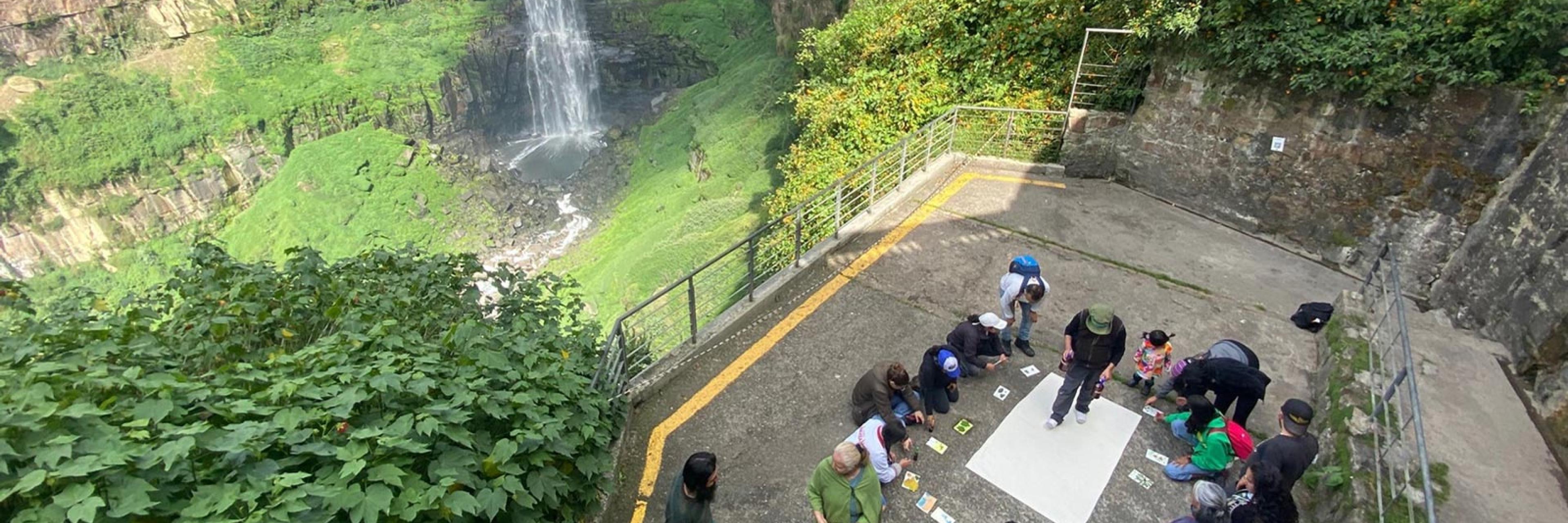
How to Care for a River? Collaborative mapping in the Bogotá River (Colombia)
For this RCN Speakers Series we are inviting Laura Giraldo-Martínez (MA Geografía | Universidad Nacional de Colombia) to talk about maps and mapping as performative tools in the case of the Bogotá River. The Bogotá River is highly protected at its source and declared dead downstream. Collaborative mapping of river commoning initiatives and care actions has the potential to link upstream protection with downstream realities, contributing to the enlivening of the river.
Please join us on Teams or in Leiden (Herta Mohr building room 0.28) on Thursday, 28 May at 15:00 CEST for this hybrid event.
The Talk
In recent decades, conservation, restoration, and legal protection of water sources and páramo socio-ecosystems have been key aspects of water management in Colombia. These Andean highland 'sponge-like' systems are considered fundamental for water regulation, biodiversity, and carbon storage. A case in point is the Guacheneque páramo, in the Bogotá River headwater, where state-centric and community-based conservation initiatives coexist (Giraldo-Martínez, et al. 2025). Yet just a few kilometres downstream, the river is rapidly transformed by agro-industrial pesticides, dairy waste, tannery discharges, and urban development. Downstream, its pollution levels along much of its course are so critical that it has been declared a 'dead river.'
In this context, where environmental policy prioritizes river conservation in the high mountains but protection fades as the river flows downstream, the question of how to narrate and represent the relationships between the upper and middle basins becomes fundamental — an answer woven together with the ways in which community-based processes and daily practices care for, value, and understand the river beyond its definition as water resource.
In this talk we focus on maps and mapping as performative tools. Maps shape rivers discursively and materially by informing decision-making processes, fixing scales and socioecological boundaries, establishing hydrological functions, and defining property and resource access or distribution. Moreover, maps carry a pedagogical function, molding how we, as riverine communities, relate to rivers.
Grounded in cartographic analysis and ethnographic and action-research approaches, conducted through collaborative and participatory methods by the entre―ríos collective in alliance with the River Commons project, we show that river commoning initiatives and care actions along the Bogotá River have the potential to link upstream protection with downstream realities, contributing to the enlivening of the river.
References:
Giraldo-Martínez, L. et al. (2025) "River mapping and the politics of eco-scalar fixes. Reconnecting upstream-downstream networks through critical cartographies of Colombia’s Bogotá River." Geoforum, 165, 104379. https://doi.org/10.1016/j.geoforum.2025.104379 entre—ríos (Eds). (2023). Cómo cuidar un río. Bogotá.
The Speaker
Laura Giraldo-Martínez is a philosopher who holds an MA in Geography, and is a PhD candidate in the River Commons project at Wageningen University & Research (movingrivers.org), a research and action program focused on learning from and with river co-governance initiatives and riverine communities across Latin America, Africa, Asia, and Europe. Her research interests articulate the fields of political ecology of water, critical geography, memory and peace studies. Through community-based participatory research and pedagogical processes, she currently addresses river care and restoration practices aimed at enlivening and commoning the Bogotá River—a rural-urban river considered one of the country's most polluted and transformed—focusing on community-based and self-organized enlivening processes. She is part of entre―ríos collective in the RÍO BOGOTÁ project (entre-rios.net/rio-bogota/).