THE NGONG’ RIVER REGENERATION PROJECT: A community-led vision for a greener, healthier and more inclusive Nairobi-Kenya
The Ngong River team will share their Ngong River Regeneration Project. Maureen Musya, Nyang’wara Chrispine, and Georgina Kasamani will present practical and participatory approaches to planning a river corridor while connecting green-blue infrastructure with communities and institutions to shape the future of the places they share.
The presentation will take place on Tuesday 8 December at 12:00 CET (14:00 EAT) on Teams. Click here to join the Teams event.
The Talk
The Nairobi River system is an important ecological asset, forming part of the headwaters of the Athi River, a critical water source for downstream communities, particularly those living in Kenya’s semi-arid regions. Yet decades of pollution from Nairobi have severely degraded the river system, affecting water quality, ecosystems and livelihoods downstream. Thwake Dam, developed to support water supply and agricultural uses, is also exposed to pollution carried through the Athi River system.
Recognising the scale of this challenge, the Government established the Nairobi Rivers Commission to coordinate efforts towards reducing pollution and regenerating the river system. AMT was recognised by the Nairobi Rivers Commission for its established footprint and experience in working with communities in Mukuru which is situated along the Ngong River.
The Commission consequently invited AMT to mobilise riverine communities along a 23 kilometres stretch (Mombasa Road to New Njiru) to facilitate their participation in developing riverine advisory and restoration plans. This work gained particular urgency following the devastating floods of April-May, 2024, which displaced thousands of households occupying riparian reserves, leaving sections of the river corridor vacant and creating an opportunity for ecological restoration and the development of public spaces.
AMT has since engaged communities along a 15.4 kilometre stretch of the Ngong River and 3 kilometres upstream of its main tributary. Additionally, AMT has developed a community-led riparian regeneration advisory plans covering 12.4 kilometres. Rather than viewing the riparian reserve solely as a conservation buffer, communities proposed transforming it into a connected network of green spaces that combines ecological restoration with social and recreational uses. These include community parks, children’s playgrounds, seven aside football pitches, walking and recreational spaces, tree planting and landscaped green corridors. In Mukuru, for example, two football pitches have been proposed, including a seven-a-side pitch, alongside other recreational facilities.
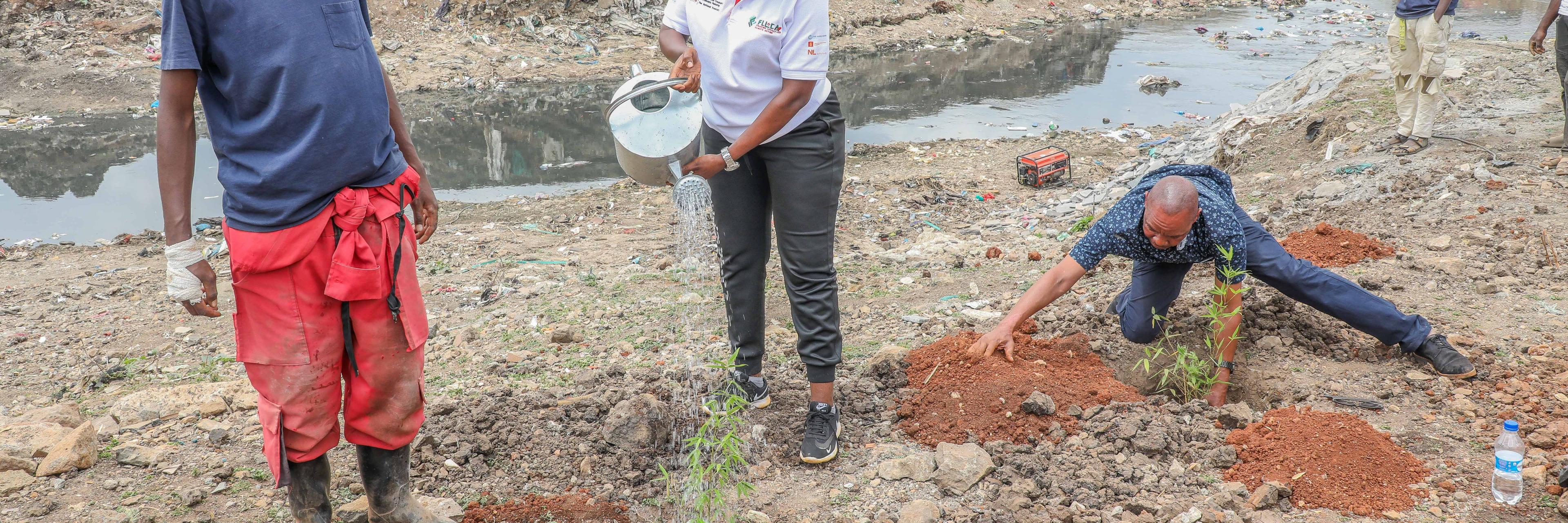
AMT has moved beyond planning to pilot implementation, developing two community parks and one children’s play area. These initiatives demonstrate how degraded riverine spaces can be transformed into accessible public assets that serve local communities while supporting environmental regeneration. To ensure that these interventions can be replicated and sustained, AMT has also developed standards for riverine planning and design for consideration and adoption by the Nairobi Rivers Commission. These standards provide a framework for integrating ecological protection, public access, recreation, safety and community needs into the planning and development of river corridors.
The Speaker(s)
Maureen Musya: Team Lead-Research Planning & MEAL
Maureen Musya is an accomplished urban and regional planner, researcher, and development professional with over seven years of experience in inclusive urban development, informal settlement upgrading, climate resilience, and land governance. She currently serves as the Team Lead for Research, Planning, Monitoring and Evaluation at Akiba Mashinani Trust (AMT), where she leads multidisciplinary teams and coordinates community-driven planning, research, and development initiatives.
She has played key roles in transformative projects, including the Mukuru Special Planning Area, Homa Bay Municipality People's Adaptation Plan, Ngong River Riparian Regeneration Initiative, and Mathare Land Governance Research. Her expertise spans participatory planning, GIS, infrastructure and service delivery, strategic partnerships, and evidence-based policymaking.
Maureen has collaborated with government institutions, international development organizations, and leading universities across Africa and beyond. She holds a Masters Degree in Planning and a First-Class Honours Bachelors degree in Urban and Regional Planning from the University of Nairobi.
Nyang’wara Chrispine: Project Lead-Riparian Planning
Chrispine is an Urban and Regional Planner and researcher with over five years of experience in community-led urban development, climate resilience, nature-based solutions and evidence-informed planning. Currently serving as Project Lead at Akiba Mashinani Trust (AMT), he spearheads integrated river regeneration initiatives along Nairobi’s Ngong River corridor, promoting ecological restoration, climate-resilient infrastructure and inclusive urban development.
His expertise spans spatial planning, GIS-based analysis, participatory research, community engagement and policy advocacy. Since 2024, Chrispine has played a pivotal role in spearheading the regeneration of over 20 kilometres of urban riparian corridors, working closely with local communities, government institutions, academic partners and development organisations to advance inclusive planning, design and implementation of riparian spaces. His work centres on integrating spatial evidence, technical expertise and community priorities to develop context-responsive interventions that restore degraded urban environments, strengthen climate resilience, enhance access to inclusive public spaces and promote equitable urban governance.
Chrispine holds a Masters degree in Planning from the University of Nairobi and a Bachelors degree in Urban and Regional Planning with IT from Maseno University. He also holds a Diploma in Project Management and a Certificate in Monitoring and Evaluation, both from the Kenya Institute of Management. He is a Graduate Member of the Kenya Institute of Planners (KIP).
Georgina Kasamani: Landscape Architect
Georgina Christian Kasamani is a Landscape Architect with experience in landscape design, community engagement, participatory planning and project implementation. Her work focuses on integrating landscape architecture with community-led approaches to urban regeneration, creating inclusive, functional and environmentally responsive spaces.
She currently serves as Lead Landscape Architect at Akiba Mashinani Trust (AMT), where she works with communities and stakeholders to co-design and support the regeneration of the Ngong River corridor in Nairobi. Her experience includes community engagement, landscape planning and design, development of 2D and 3D visualisations, site management and implementation of landscape interventions. She has also contributed to research on Nature-Based Solutions for the regeneration of the Nairobi River.
Georgina holds a Bachelor of Landscape Architecture. She is passionate about participatory urban development, ecological restoration and creating public spaces that strengthen the relationship between people, nature and the built environment.
The River Cities Network presentation series
The River Cities Network presentation series is an online platform for teams in the River Cities Network (RCN) to introduce their river-city case study projects to other members of the network and to an external audience. Teams have approximately 30 minutes to present their projects, after which there will be approximately 30 minutes for discussion. RCN teams that are interested in presenting can contact rcn@iias.nl.
Header image: by Akiba Mashinani Trust.